200 Breaststroke
| Event | 200 Breaststroke |
|---|---|
| Distance | 200 metres |
| Stroke | Breaststroke |
| Pool length | 25m or 50m |
| Course type | Long Course or Short Course |
| Governing body | World Aquatics (FINA) |
| Gender category | Men's and Women's |
| Age category | Senior, Junior, Masters |
Overview
The 200-meter breaststroke is a competitive swimming event contested in both long-course and short-course pools. It is one of the four standard stroke disciplines featured in major international competitions, alongside freestyle, backstroke, and butterfly. Swimmers must complete eight lengths of a 50-meter pool, or sixteen lengths of a 25-meter pool, using only the breaststroke technique as defined by the sport's governing body, World Aquatics. The event demands a unique combination of explosive power, precise technical timing, and exceptional endurance. It is considered one of the most technically demanding and physically taxing races in competitive swimming due to the high resistance of the stroke. Races are typically swum by gender at elite levels, with athletes competing in preliminary heats, semifinals, and a final to determine the medalists.
History
The breaststroke is the oldest of the modern competitive swimming strokes, with its origins traceable to European instructional texts from the 16th century. The specific 200-meter distance for the breaststroke, however, emerged much later as competitive swimming formalized its event slate in the late 19th and early 20th centuries. The men's 200-meter breaststroke was first introduced to the Olympic Games program in 1908, held in London, solidifying its status as a core international event. The women's 200-meter breaststroke was added to the Olympic schedule later, debuting at the 1924 Paris Games. The stroke's rules have evolved significantly over the decades, particularly regarding the underwater pull and the kick, to distinguish it from the developing butterfly stroke. Early pioneers of the event often used a wider, more scissor-like kick, whereas the modern era is defined by a narrower, whip-like action that generates greater propulsion.
How it works today
Today, the 200-meter breaststroke is governed by a strict set of technical rules defined by World Aquatics to ensure uniformity and fairness. After the start and following each turn, the swimmer is permitted one full underwater arm pull and one dolphin kick before initiating the first breaststroke kick and surfacing. The swimmer's hands must be pushed forward together from the breast and must not be brought back beyond the hip line at any point during the stroke cycle. The feet must be turned outward during the propulsive phase of the kick, and a scissor, flutter, or downward dolphin kick is not permitted except for the single dolphin kick allowed after starts and turns. The head must break the surface of the water at least once during each complete stroke cycle, except for the one stroke cycle allowed after the start and each turn. Race strategy is critical, with swimmers balancing early speed against the severe lactic acid buildup that characterizes the final 50 meters of the race.
Why it matters
The 200-meter breaststroke serves as a key benchmark for technical proficiency in swimming, testing an athlete's ability to maintain a complex, rule-bound technique under extreme fatigue. It is a cornerstone event in the sport's portfolio, essential for determining all-around champions in individual medley competitions. Performances in this event drive advancements in sports science, particularly in understanding muscle endurance, lactate tolerance, and underwater streamline dynamics. The event's history provides a direct link to the earliest days of competitive swimming, preserving a stroke that has been practiced for centuries. Mastery of the 200-meter breaststroke is often seen as a mark of a swimmer's dedication and discipline due to the relentless training required for success. Its inclusion in every major championship, from the Olympics to World Championships, underscores its fundamental role in the fabric of international aquatics.
Common misconceptions
A common misconception is that the breaststroke is the slowest competitive stroke simply because it is less efficient; in reality, its speed is a direct result of the strict technical rules that limit the swimmer's propulsion phases and mandate a specific recovery period. Another fallacy is that powerful leg strength alone is sufficient for success, when in fact elite performance hinges on the perfect synchronization of the pull, kick, and breath, with a weak upper body being a significant disadvantage. Some believe the single dolphin kick after starts and turns is optional or unlimited, but the rules explicitly permit only one such kick per wall before the breaststroke kick must begin. It is also incorrectly assumed that the stroke is inherently easier on the shoulders than freestyle or butterfly, whereas the unique mechanics of the breaststroke pull place substantial stress on the knees and inner thigh muscles, leading to distinct overuse injuries. Novices often think the head must be above water at all times, but the rules allow the head to submerge during the glide phase as long as it surfaces once per stroke cycle. Finally, many spectators underestimate the strategic depth of the race, viewing it as a simple test of endurance rather than a nuanced battle of pace, technique preservation, and tactical lane placement.
Latest 200 Breaststroke news
Latest reporting

Van Mathias Sets American Records in 50 and 100 Breaststroke
Van Mathias returned to competition in 2025 after a two-year hiatus and went on to break American records in both the 50-meter and 100-meter...
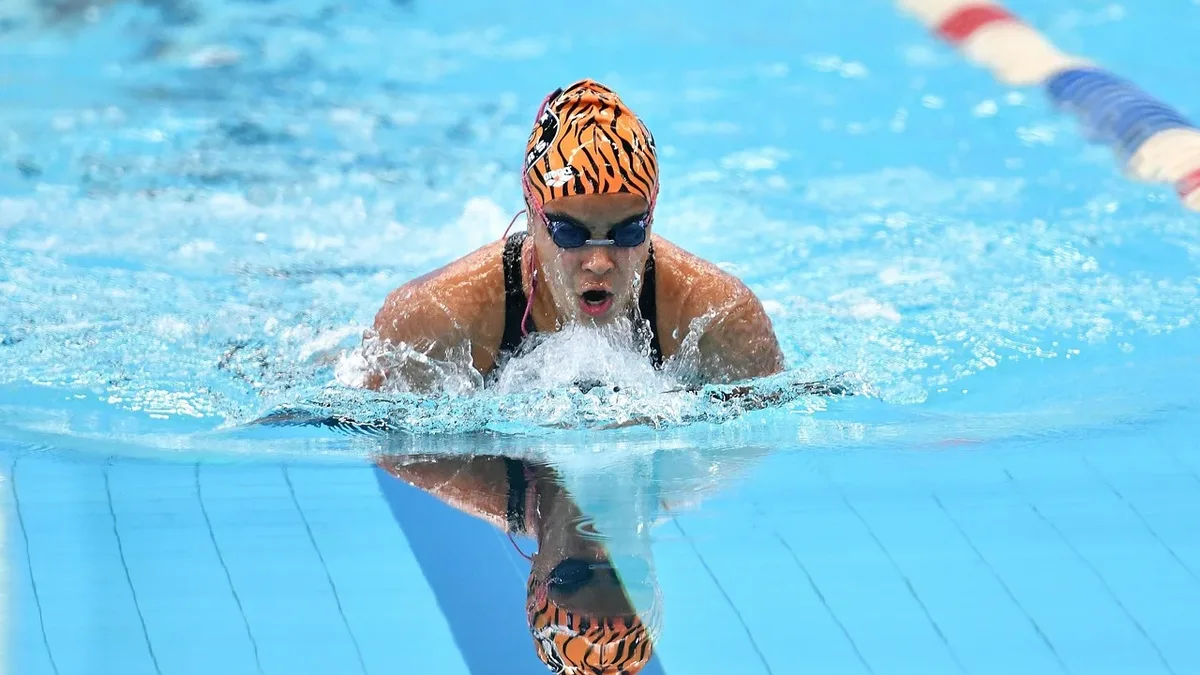
McKenzie Siroky's hockey-to-swimming pivot leads to Pan Pacs
Former hockey prospect McKenzie Siroky, 21, won the 100m breaststroke at the 2026 Pan Pacific Championships. Her time ranks second in the world this...

Penn's Nguyen, Whittington debut at NCAA
Penn sophomores Watson Nguyen and Peter Whittington made their NCAA championship debuts, with Nguyen placing 28th and 26th in breaststroke events and
Top 20 NCAA Recruits: Girls Class of 2027
SwimSwam has released a ranking of the top 20 girls in the high school class of 2027 after their junior year, highlighting athletes who have achieved...

Angiolini secures double gold in Taranto
Italian Lisa Angiolini won the 50m breaststroke at the Mediterranean Games to claim her second title alongside her 200m breaststroke victory.
Benedetta Pilato Wins Gold
Benedetta Pilato has added the 100 breaststroke gold to her European bronze at the Mediterranean Games