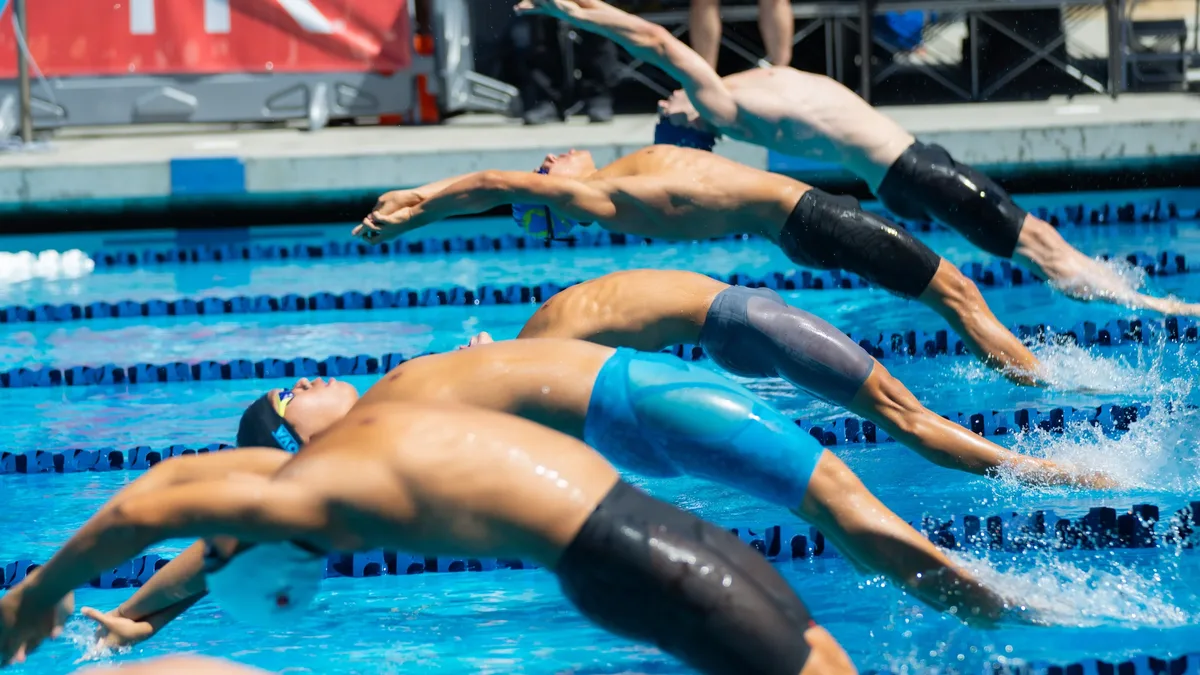
Caeleb Dressel's Coaching Trio Forges Unconventional Path
Caeleb Dressel, after a limited 2025 season, assembled a new coaching and science team to pursue a fourth Olympic bid.

Caeleb Dressel assembled a new, unconventional coaching team in late 2025 to pursue a fourth Olympic appearance. The seven-time Olympic gold medalist, after a season racing only in 50-meter events and skipping U.S. Nationals, sought a fresh approach for the Los Angeles 2028 cycle, according to a report from Swimming World Magazine.
Dressel reached out to three specialists who had no prior working relationship. He reunited with his former University of Florida sprint coach, Steve Jungbluth, for technical guidance. For sports science, he contacted physiologist Eva Piatrikova on a recommendation from a mutual friend. Finally, he hired strength and conditioning coach Sean Kao, who was recommended by former USA Swimming sports science director Keenan Robinson.
"When Caeleb decided to come back to swimming and put together his new team, he was looking for a scientist," Piatrikova told the publication. The trio quickly began coordinating via regular video calls to track Dressel's training data and make adjustments. Dressel emphasized his desire for a highly personalized program. "I wanted to be high maintenance," he said. "With the group I put together, I didn't want anyone to have total control."
Reuniting with Steve Jungbluth
Logistics presented the first major hurdle for Dressel and Jungbluth. Jungbluth had moved to Jacksonville to lead the Sporting Jax Aquatic Club, while Dressel was adamant about training near his family in Gainesville. They settled on an unusual schedule: Dressel would drive two hours to Jacksonville every Monday, train, stay overnight, and have another session Tuesday morning before returning home. He would repeat the trip for two more sessions on Thursday and Friday, totaling just four swims per week.
The training volume was a dramatic departure from Dressel's past. Jungbluth told Swimming World Magazine the similarities to their previous work were "almost zero." Where Dressel once completed nine practices of around 6,000 meters each week, the new regimen involved four sessions of 2,000 to 3,000 meters, maxing out at 3,500. The first two months were even lighter, focused on rebuilding technique.
"I was teaching him how to swim again," Jungbluth said. He felt Dressel's freestyle technique had deteriorated over six or seven years. The initial eight weeks involved extensive drilling and slow swimming. The evolved schedule included aerobic work on Monday, freestyle power on Tuesday, butterfly power on Thursday, and a lactate set on Friday. Jungbluth cited a set where Dressel performed 60-meter repeats, simulating the back half of a 100-meter race. In the weeks before Nationals, Dressel was reportedly pushing times of 24.0 and 23.9 seconds on these efforts.
Strength and Science Coordination
The coaching team decided to temporarily shift focus from strength development to pool work. Sean Kao, the strength coach based in California, said they put Dressel's strength and power development on "maintenance" for most of the season to prioritize the technical work prescribed by Jungbluth and Piatrikova. Kao anticipated metrics like vertical jump would drop, with a plan to rebuild them in time for the national championships.
Kao called Dressel "one of the most coachable athletes I've ever worked with." This allowed for effective remote collaboration. Dressel logs workouts in an app for Kao to monitor and sends videos for feedback. They agreed on occasional in-person reassessments in California. Kao emphasized the value of Dressel's trust, which allows the team to clearly correlate training inputs with performance outputs.
Physiologist Eva Piatrikova, based in Slovakia, conducts testing on Dressel's efficiency, anaerobic capacity, VO2, and blood lactate, and manages his nutrition. She travels to work with him in-person every two months and communicates her findings to Jungbluth and Kao to tailor training sets. For example, she provides optimal post-race recovery times and has worked with Jungbluth to adjust rest intervals in power rack sets.
"I think the most exciting thing for me is that Caeleb responds very well to training when it's prescribed based on his data and his current needs," Piatrikova said. She believes his best years are still ahead.
Moving Forward With Confidence
The team's work culminated in a successful performance at the 2026 Toyota U.S. Nationals, where Dressel posted the country's fastest time of the year in the 50-meter freestyle. The result boosted Dressel's confidence and validated the unconventional approach for his coaches.
Piatrikova said her main takeaway was confidence that their chosen path was correct. The coaches plan to continue the current structure into the 2026-27 season, with the most significant changes expected in the gym. After a prolonged maintenance phase, Kao intends to lead Dressel into a lengthy period of strength development. The trio remains in close contact, already plotting the next steps following the national meet.