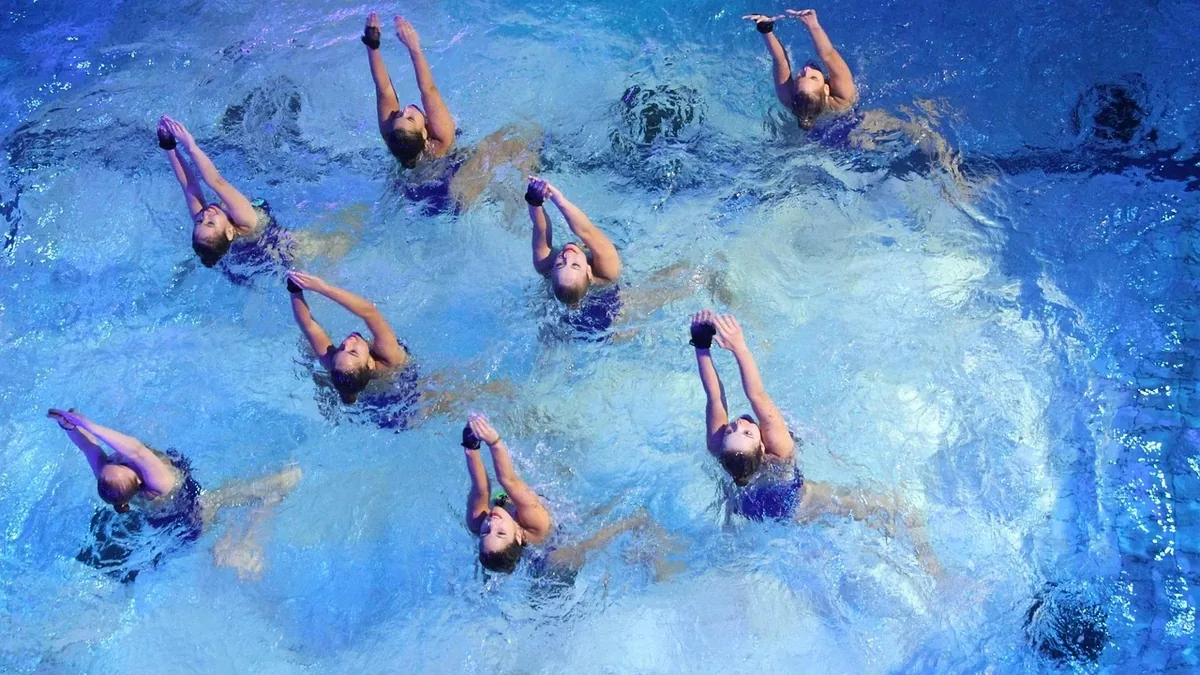
World Aquatics Championships
| Organising body | World Aquatics |
|---|---|
| First held | 1973 |
| Frequency | Biennial (odd-numbered years) |
| Disciplines | Swimming, Diving, Water Polo, Artistic Swimming, Open Water Swimming, High Diving |
| Qualification | Via national federation selection and meeting time/mark standards |
| Duration | Approximately 17 days |
| Venue | Changes per edition |
Overview
The World Aquatics Championships is the premier international competition for aquatic sports, organized by World Aquatics, the global governing body. It features events in swimming, diving, water polo, artistic swimming, open water swimming, and high diving. The championships are held biennially in odd-numbered years, typically during the summer months, though host cities can vary across continents. The event brings together thousands of athletes from over 190 member federations to compete for world titles. It serves as a critical qualifying meet for the Olympic Games and sets the competitive standard for the aquatic disciplines between Olympic cycles.
History
The World Aquatics Championships originated from the global governing body for swimming, FINA, which was founded in the early 20th century in London. The first official edition was held in 1973 in Belgrade, Yugoslavia, establishing a standalone world championship for aquatic sports. Prior to this, world championship events in swimming and diving were only held as part of the Olympic Games program. The event was initially held at irregular intervals but settled into a biennial schedule from the early 2000s onward. The championships have expanded significantly since their inception, adding open water swimming in 1991, high diving in 2013, and adapting artistic swimming from its earlier form of synchronized swimming. This growth reflects the evolution and increasing specialization within the aquatic sports governed by the federation.
How it works today
The modern World Aquatics Championships operate under a strict qualification system where athletes must meet entry times or scores set by World Aquatics or earn selection through continental or national federation processes. The event is hosted by a city selected through a bidding process years in advance, requiring a main swimming pool, a separate diving well, a water polo arena, and access to an open water venue. Competition schedules are tightly packed over approximately two weeks, with sessions for preliminaries, semifinals, and finals across all disciplines. A detailed points table ranks nations based on final placements, with the winner of each individual event and relay earning the title of world champion. World records set at the championships are officially ratified by World Aquatics, provided all technical rules are met. The organization also conducts anti-doping controls in accordance with the World Anti-Doping Code throughout the event.
What to know
The championships are distinct from the Olympic aquatic program, often featuring non-Olympic events like the 50-meter distances in strokes, mixed-gender relays, and team events in artistic swimming and diving. Qualification for the Olympics is not automatic with a world championship win; athletes and teams must still meet separate Olympic qualifying standards, though the championships often serve as a primary qualifying meet. Hosting the event is a massive logistical and financial undertaking, with cities building new facilities or extensively renovating existing ones to meet exacting technical standards. The level of competition is considered the highest outside of the Olympic Games, with depth in fields often greater due to the absence of per-country entry limits present at the Olympics. Media rights and broadcasting are managed centrally by World Aquatics, determining global coverage. Attendance and viewership figures can vary significantly depending on the host time zone and the prominence of aquatic sports in the host region.
Common questions
What is the difference between World Aquatics and FINA? World Aquatics is the new name adopted in 2023 for the international federation formerly known as FINA; it is the same organization. How often are the World Aquatics Championships held? They are held every two years, in odd-numbered years, to alternate with the Summer Olympic Games. Can a swimmer compete in both the World Championships and the Olympics in the same year? No, as the championships are held the year before or after an Olympic year, avoiding direct annual conflict. Why are some world records from the championships later rescinded? Records can be invalidated due to technical infractions like illegal swimsuits, pool depth irregularities, or doping violations discovered after the fact. Do all aquatic sports have the same number of medal events? No, swimming has the most events, while high diving has the fewest, with the program periodically reviewed and adjusted. How are host cities chosen? Cities submit bids years in advance, evaluated by World Aquatics on criteria including facilities, funding, legacy plans, and organizational capability.
Why it matters
The World Aquatics Championships establish the definitive annual hierarchy in aquatic sports outside the Olympic cycle, providing a consistent benchmark for athlete and national program development. Success at this event directly influences funding allocations for national federations and can shape career trajectories for athletes through sponsorships and recognition. The championships drive innovation in training methodologies, technique, and sports science as coaches and athletes analyze the performances of global rivals. For the host nation, the event can accelerate the development of aquatic sports infrastructure and inspire participation at the grassroots level, leaving a lasting legacy. The competition also serves as a critical test event for new rules, technologies, and officiating protocols before their implementation at the Olympic Games. It consolidates the global aquatic community, facilitating technical congresses and meetings that govern the future direction of the sports.
Common misconceptions
A common misconception is that winning a world championship title guarantees an athlete an Olympic medal or even Olympic qualification, which is not true due to separate qualifying processes and the different competitive landscape of an Olympic year. Another is that all world records set at the championships are universally recognized forever, when in fact records can be stripped years later due to retroactive doping bans or technical disqualifications. Some believe the event is always a financial success for the host city, but many editions have required significant public subsidy and have struggled with attendance for preliminary sessions or less popular disciplines. It is also incorrectly assumed that the level of competition is identical to the Olympics, whereas the Olympics have stricter entry limits per country, sometimes leading to deeper and more unpredictable fields at the world championships. Finally, many think the federation's rules are static, but the championships often debut new event formats or technical rules that can significantly alter strategies and outcomes.
Latest World Aquatics Championships news
Latest reporting
Angharad Evans Details NCAA Exit, Comeback to World-Class
Breaststroker Angharad Evans discusses her difficult year at the University of Georgia, her break from swimming, and her subsequent rise to win seven
Cameron McEvoy to Race 100 Free at Silk Road World Cup
World record holder Cameron McEvoy will test his 100m freestyle at the Silk Road World Cup Tour next month, aiming for a relay spot at the Short...

European Aquatics President Silva Outlines LA28 Strategy
European Aquatics President Antonio Silva details the organization's strategic priorities, including strengthening junior-to-senior pathways and...
Swimming World Magazine Offers Five Tips for a Successful
Summer Finke, a U.S. Olympic Trials qualifier, outlines five mental and practical strategies for swimmers to build a successful season, focusing on

Smith's Return to Racing Anticipated at South African SC
Tatjana Smith's entry into the 2026 South African Short Course Championships has generated excitement among teammates and officials.
Tatjana Smith Returns for South African Short-Course
Retired Olympic champion Tatjana Smith will compete at the South African Short-Course Championships from September 24-27, aiming for a World...